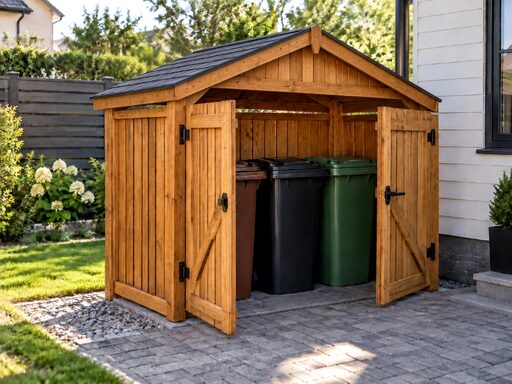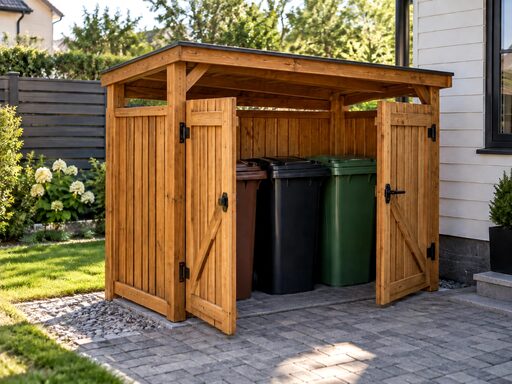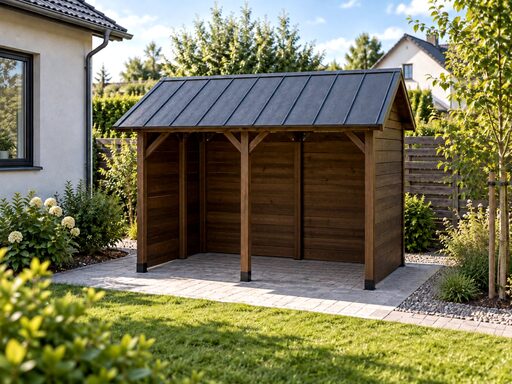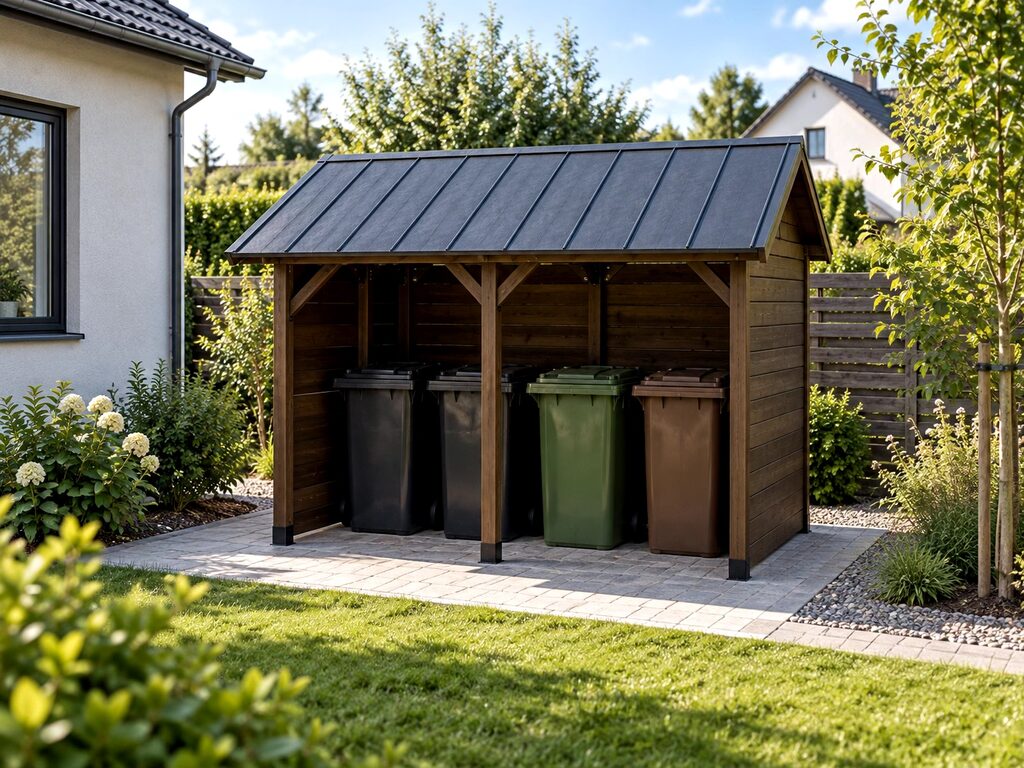
Learn how to prepare the foundation for a waste container shelter – paving, concrete, level surface, water drainage, and practical tips before installation.
A properly prepared foundation is one of the most important steps before installing a waste container shelter. Even a well-made wooden structure will be much more convenient for everyday use if it is on a flat, stable, and suitable surface for the specific location.
The foundation affects not only the stability of the shelter itself but also how easy it will be to push the containers out, put them back, and keep the entire waste storage area clean.
We manufacture wooden waste container shelters to individual order, so the choice of foundation should also be considered together with the size, location, and conditions of the yard.
Waste containers are regularly moved, so the surface under the shelter must be practical for everyday use.
If the structure is placed on an uneven or too soft surface, several problems may arise:
Therefore, we recommend preparing the foundation even before installing the waste container shelter.
Before thinking about the foundation material, a suitable location for the shelter must be chosen.
It is important that the containers can be easily accessed both on a daily basis and on waste collection days.
We recommend considering:
It is best if the waste container location is in a practical place where containers do not need to be carried across the lawn or uneven surface.
One of the most important conditions is levelness.
The structure must be on a stable surface so that the walls, doors, and roof structure function correctly after installation.
If the foundation is slanted, problems may arise over time with:
Therefore, we recommend checking the level of the intended location before installation.
Paved foundation is one of the most practical solutions for the container area.
Its main advantage is a smooth and relatively even surface, which allows for easy movement of containers with wheels.
Paving is also easy to maintain.
It can be:
If there is already a paved driveway or path in the yard, the wooden waste shelter can sometimes be planned to be right next to this area or on a suitable existing foundation.
The specific installation solution must be evaluated individually.
Another possible option is a concrete foundation.
This may be suitable in situations where a stable and easily maintainable surface is needed for a larger container area.
The concrete surface is also practical for moving containers, as the wheels move easily over it.
However, before creating a concrete foundation, it is important to know precisely:
Therefore, if an individual waste container shelter is planned, it is advisable to first agree on the dimensions of the structure and only then create the foundation.
In certain projects, a well-prepared and compacted mineral material foundation can also be used.
This approach may be suitable in places where it is not necessary to completely pave or concrete the entire area.
However, for moving containers, the practicality of the surface must be considered.
If the gravel is too coarse or the surface is uneven, it may be harder to move the container wheels.
Therefore, a smoother and more stable surface is generally more convenient for the path of container movement.
Theoretically, in certain projects, structures can also be installed in areas surrounded by lawn, but it is worth planning a more stable solution under the shelter itself and in the container movement area.
The lawn can be problematic for several reasons:
Therefore, in the long term, it is more practical to create a separate prepared area.
Often, the foundation of the shelter itself is carefully prepared, but the path along which the containers will be pushed is forgotten.
This is especially important in winter and rainy weather.
If a heavy container has to be pushed from the shelter to the gates over:
everyday use can become inconvenient.
Therefore, when planning the waste container location, we recommend looking at the entire route from the shelter to the place where the containers are handed over to the waste collector.
The foundation should not be in a place where water regularly accumulates after rain.
This is important for both the use of the containers and the wooden structure.
Prolonged accumulation of water and moisture around wooden parts is undesirable.
Therefore, even before installing the shelter, it is necessary to evaluate:
This is especially important for a single-slope roof waste shelter.
If the roof slopes backward, a place must be provided where rainwater can safely go afterward.
In the case of a single-slope roof, we recommend planning the structure so that precipitation is not directed in front of the entrance.
A practical solution in many projects is:
a higher front → roof slopes backward → rainwater is directed away from the entrance area.
Then, when a person opens the shelter doors or pushes out the container, water does not flow directly in front.
However, there must also be a suitable place for water drainage at the back.
In the case of a gable roof, precipitation is directed to both sides of the roof.
Therefore, it is necessary to check what is located along both sides of the shelter.
A situation should not be created where water is regularly directed:
Roof and foundation solutions should be considered together.
When planning the area, it is not enough to calculate only the sizes of the containers.
The structure itself and the daily movement area must also be taken into account.
Space is needed for:
That is why we recommend first determining the size of the waste container shelter and only then preparing an accurate foundation.
We manufacture structures of various sizes.
For example:
These are just examples.
The size of each structure is chosen based on the number of containers, available space, and the client's needs.
Therefore, the size of the foundation must also be adjusted to the specific project.
If a custom-made shelter is planned, it is advisable to avoid a situation where a precise concrete or paving platform is created first and only then an attempt is made to find a suitable structure for it.
A more practical sequence is:
This way, it is possible to avoid unnecessary reconstruction or expansion of the foundation.
We manufacture wooden waste container shelters to individual order.
The project can be customized for:
Material cross-sections and construction solutions are chosen according to the size and requirements of the specific project.
Therefore, the precise installation and foundation solution must also be evaluated for the specific project.
If you are planning a waste container shelter but do not yet know how to prepare the area, you can send us:
We can help understand what sizes are needed for the structure itself and what other information needs to be prepared.
Questions and photos of the area can also be sent to us via WhatsApp.
Depending on the specific project, the waste container shelter can be prepared in production and delivered in disassembled form.
This means that the client can choose to assemble the structure themselves.
In this case, it is especially important that the assembly location is already properly prepared and level.
Depending on the project and the location of the object, it is also possible to agree with us on assembly options.
The precise configuration, delivery, and assembly solution are coordinated individually.
There is no single type of foundation that is suitable for all projects.
In a private house, a practical solution is often a flat paved or other stable surface suitable for moving containers. In certain situations, a concrete or prepared mineral material foundation can be used.
The most important thing is that the foundation is:
We recommend first choosing and agreeing on the size of the waste container shelter and only then preparing an accurate foundation.
This way, it is possible to create not only a visually organized but also a practical container area that will be easy to use for many years.
We usually reply within an hour on working days.
We use cookies to understand how the site is used. They are only switched on with your consent.