Single-pitched or double-pitched roof for a waste container shelter? We compare both options, rainwater drainage, design, and custom manufacturing possibilities.
When planning a waste container shelter, the roof shape is one of the most important choices. It affects not only the appearance of the shelter but also how rain and snow are drained, how well the structure fits into the yard, and how conveniently the shelter can be used on a daily basis.
The two most commonly chosen solutions are single-pitched roof and double-pitched roof.
Both options can be suitable for a small private house container placement as well as a larger shelter for several household and sorted waste containers. The right choice depends on the size of the structure, its location, the architecture of the house, and the client's preferences.
We manufacture wooden waste container shelters to individual order, so the roof solution can be tailored to the specific project.
The main task of the roof is to protect the containers and part of the wooden structure from direct precipitation impact.
However, its practical significance does not end there.
The roof shape also affects:
Therefore, we recommend choosing the roof together with the entire waste container placement project.
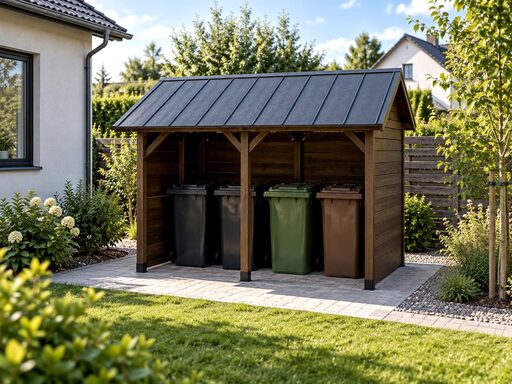
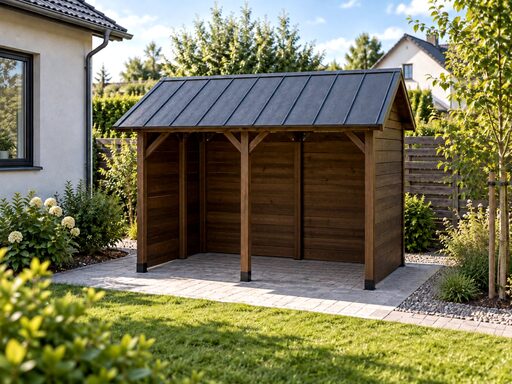
Single-pitched roof for a waste container shelterA single-pitched roof is a simple and modern solution.
It has one roof plane that slopes to drain rainwater in one direction.
This type of roof fits particularly well in modern and minimalist architecture.
One of the biggest advantages is visual simplicity.
A wooden waste shelter with a single-pitched roof can fit well:
This type of shelter can be made both small and larger.
One of the most important practical questions is the direction of the roof slope.
If there are doors or a main entrance at the front of the shelter, we recommend designing the roof so that rainwater is drained to the back of the shelter, not onto the person standing at the door.
This means that the front part can be higher, but the roof slopes to the back.
This solution is particularly practical because:
Of course, the exact direction of the roof slope should be chosen based on the specific location.
A single-pitched roof is often chosen when the shelter is:
This type of roof can also look good for a larger waste container placement, if it is necessary to maintain a simple and functional design.
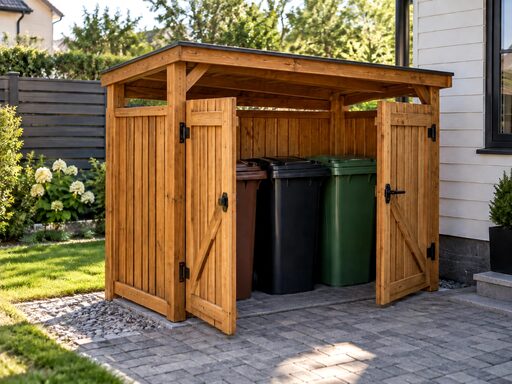
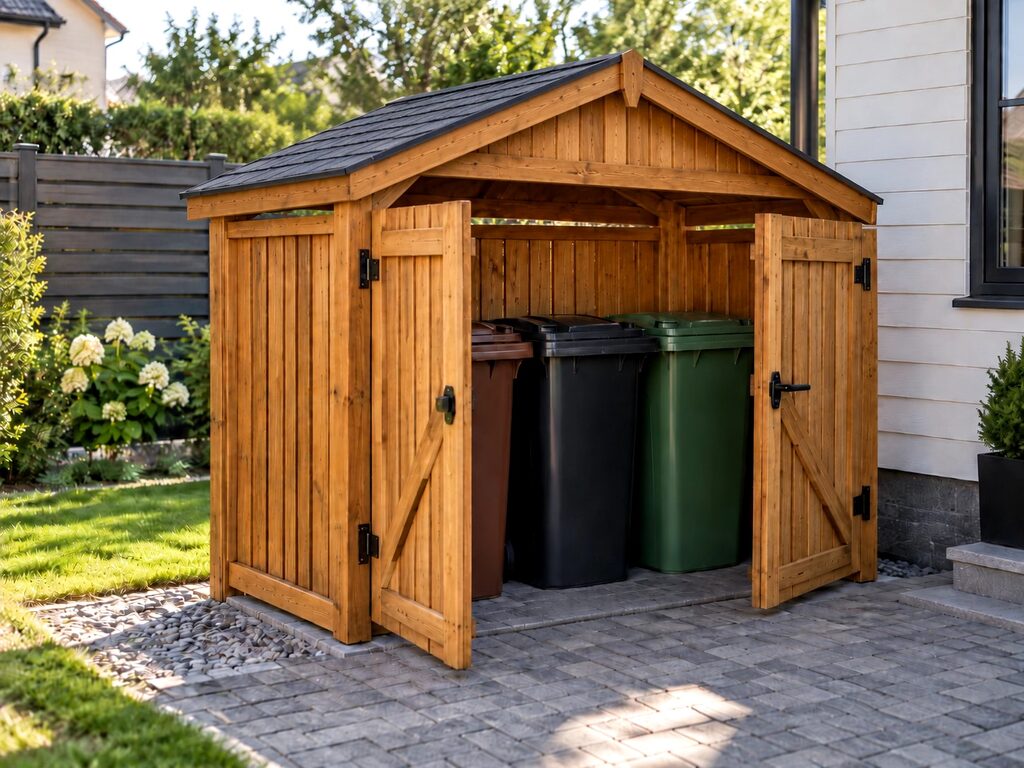
Double-pitched roof for a waste container shelterA double-pitched roof is formed from two roof planes that connect at the top.
This gives the structure a more classic and traditional appearance.
This solution is often chosen if the goal is for the waste shelter to visually resemble a small garden or utility building.
A double-pitched roof can fit very well on a property where the residential house also has a similar roof shape.
This allows the waste container shelter to be visually linked with the rest of the area.
A double-pitched roof can look particularly good:
This type of roof gives the structure a more pronounced and complete form.
If a larger waste container placement for several containers is needed, a double-pitched roof can be visually very suitable.
For example, larger structures can be:
These sizes are just examples.
We can also manufacture other sizes depending on the number of containers and the specific location.
Both single-pitched and double-pitched roofs can perform their function well if they are properly constructed.
More important than the roof shape itself is:
Therefore, it cannot be said that one type of roof is always better than the other.
Both are practical if they are tailored to the specific project.
This is primarily a question of architecture and practicality.
A single-pitched roof often fits better with a modern private house with simple lines.
A double-pitched roof may be more suitable for a traditional house with a pronounced roof shape.
A good principle is to look at the entire yard as a whole.
If the house has:
then a container shelter with a single-pitched roof can also look harmonious.
On the other hand, if the house has a classic double-pitched roof, a similar solution for the waste shelter can create a unified overall view.
Not only the shape is important, but also the color.
The roof can be visually matched to:
For example, a dark gray roof contrasts well with a light brown wooden structure.
On the other hand, browner roof tones can create a warmer and more traditional overall appearance.
We recommend choosing the roof color together with the color of the entire wooden waste shelter.
If the container placement is intended to have doors, the roof shape should be planned together with the entrance.
Especially in the case of a single-pitched roof, it is important that water is not drained directly to the place where a person stands when opening the doors.
Therefore, in many projects, it is practically:
the front is higher → the roof slopes to the back → rainwater drains away from the entrance.
This is a simple but very essential design principle.
In the case of a double-pitched roof, it is also necessary to evaluate where precipitation will fall from both sides of the roof.
If a waste container shelter is located next to a fence, the drainage of rainwater must also be considered.
It is not desirable for roof water to uncontrollably flow:
Therefore, the roof solution is closely related to the specific location of the shelter.
The roof helps reduce direct precipitation impact on part of the wooden structure, but this does not mean that the shelter does not require maintenance.
We recommend regularly checking:
Wooden outdoor structures are affected by the sun, rain, snow, humidity, and temperature changes.
Regular maintenance helps preserve both the appearance and functionality of the structure.
The larger the structure, the more important it is to view the roof solution as part of the entire building.
For a small shelter for one or two containers, a single-pitched roof is often a very practical and visually light solution.
For a larger waste container placement, both single-pitched and double-pitched roofs can be chosen.
The choice depends on:
The material cross-sections and the construction solution are chosen according to the specific project's size and requirements.
We manufacture wooden waste container shelters to individual order.
This means that it is possible to customize not only the roof but also the entire structure.
We can coordinate:
The size of the shelter can be, for example, 1.3 × 1.3 m, 2 × 3 m, 3 × 3 m, 3 × 4 m, 4 × 4 m, 3 × 5 m, 3 × 6 m or in any other individually required size.
If it is unclear whether to choose a single-pitched or double-pitched roof for a specific location, you can send us:
With this information, it is possible to understand much better what type of roof and construction solution will fit into the specific property.
If necessary, you can also contact us via WhatsApp.
Depending on the project, the construction can be prepared for production and delivered in disassembled form.
The parts are prepared in the necessary sizes, processed, painted, checked, and assembled for delivery.
This allows for the option of DIY or self-assembly.
Depending on the project and the location of the object, it is also possible to agree with us on assembly.
The exact assembly, delivery, and installation options are coordinated individually.
Both options can be a good choice.
A single-pitched roof is suitable for those who want a simple, modern, and practical design. It is especially important to choose the slope direction correctly so that rainwater is not drained in front of the entrance. In many cases, it is practical to make the roof higher at the front and lower at the back.
A double-pitched roof is more suitable for those who want a more classic building appearance and want the shelter to visually match a house with a similar roof shape.
We can manufacture both options and customize the waste container shelter to the specific property, the number of containers, and the client's preferences.
The most important thing is not to choose the roof solely based on appearance but to combine design with practical daily use.
We usually reply within an hour on working days.
We use cookies to understand how the site is used. They are only switched on with your consent.