Why does a waste container canopy need a roof? Learn about protection against rain and snow, types of roofs, and individual solutions.
When choosing a waste container canopy, attention is often paid to its size, walls, doors, and design. However, an equally important part of the structure is the roof.
A waste container canopy with a roof helps protect the containers and the area itself from direct rain, snow, and other precipitation, while also making the structure visually more complete.
In Latvia's variable weather conditions, the roof is not just a decorative element. It significantly affects how comfortably the canopy can be used daily and how well it fits into the specific yard.
We manufacture wooden waste container canopies of various sizes, and the roof solution can be customized to the specific project, size, and desired design.
One of the main tasks of the roof is to reduce the impact of direct precipitation.
Without a roof, the containers are constantly exposed to the open sky. During rain, water accumulates on the lids and around them, while moisture also affects the area of the container placement.
A waste container canopy with a roof helps create a more protected space, especially if the structure also has side or back walls.
This does not mean that the canopy becomes completely sealed from the weather, but it significantly reduces the direct impact of precipitation on the containers.
In winter, using waste containers can become inconvenient if their lids are covered with snow or ice.
The roof helps reduce the amount of snow that falls directly onto the containers.
This is practical because there is no need to clear a thick layer of snow every time before opening the container.
Of course, snow can still enter the canopy from the sides, especially in windy weather, so the roof does not provide complete protection. However, a container canopy with a roof can make daily use in winter significantly more convenient.
In autumn, a lot of leaves can accumulate in the open container area.
If the containers are located under a tree or close to shrubs, leaves can end up both on the containers and between them.
The roof helps reduce the amount of dirt that falls directly from above.
This, in turn, can make maintaining the waste container area in order easier.
Regular cleaning is still necessary, but an area under a roof is usually more protected than a completely open space.
Wooden outdoor structures are affected year-round by sun, moisture, rain, snow, and temperature fluctuations.
The roof helps protect part of the structure from direct precipitation.
This especially applies to the walls, boards, and other details under the roof.
However, a wooden waste canopy with a roof also requires regular maintenance.
We recommend periodically checking:
If the coating is worn, it should be restored with a protective coating suitable for outdoor wooden structures.
A waste container canopy does not have to look like just a simple technical structure.
A well-chosen roof significantly affects the overall appearance.
It can help visually match the canopy to:
If the house has a distinct roof style or color, a similar solution for the waste area can help create a cohesive yard architecture.
We recommend choosing the roof shape together with the design of the entire structure, rather than viewing it as a separate element.
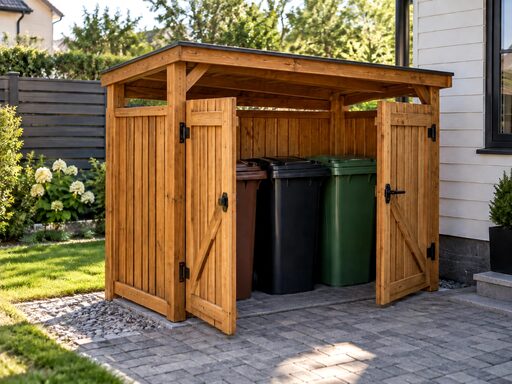
One possible solution is a single-slope roof.
This creates a simple and modern appearance for the structure.
A single-slope roof can fit well:
This type of roof can be made with a slope towards the back of the structure or another side suitable for the project.
The specific solution is chosen according to the location and project of the canopy.
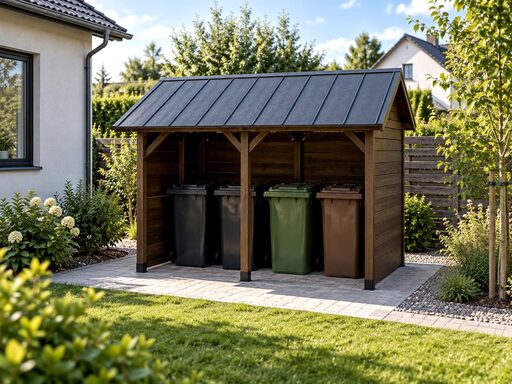
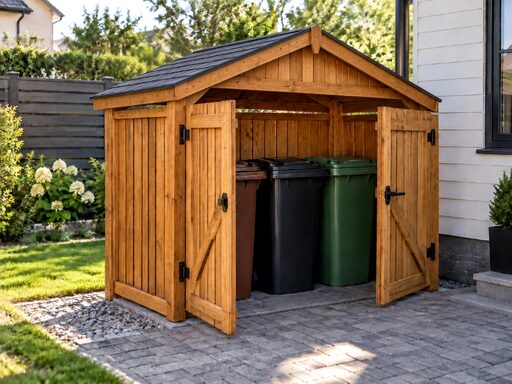
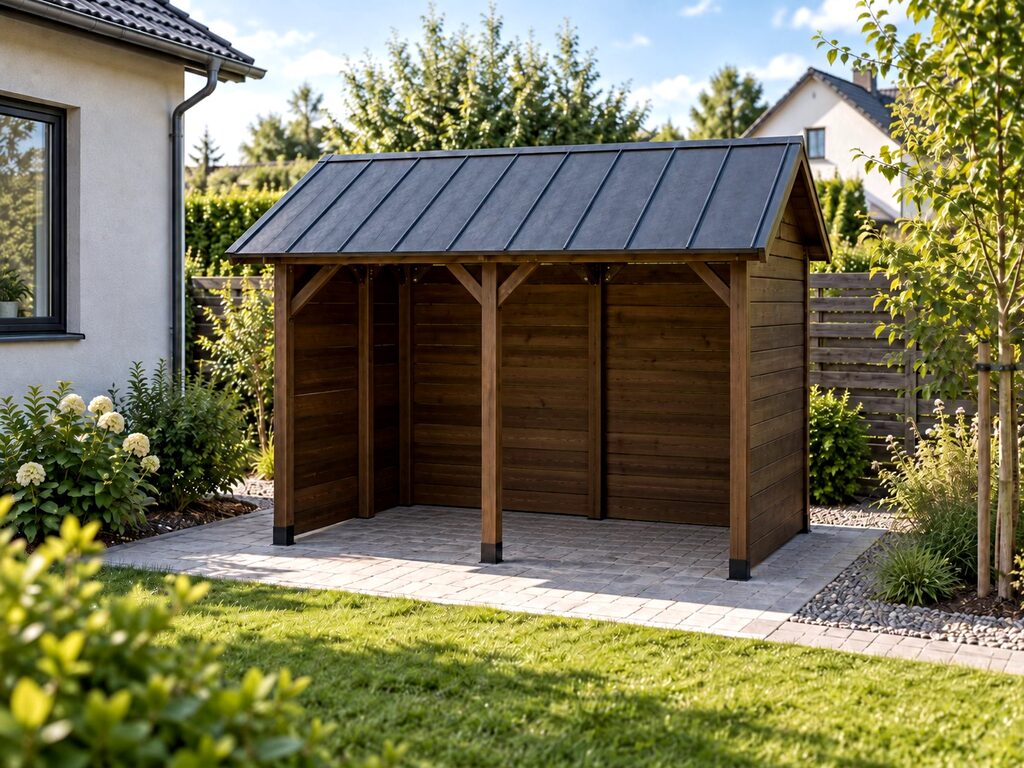
The second option is a gable roof.
This gives the wooden structure a more traditional building appearance.
A gable roof can fit well on a property where the house, garage, or other buildings have a similar roof shape.
It can also be suitable for larger waste container areas, where the size of the structure visually resembles a small outbuilding.
We can coordinate the roof shape with the placement of the walls, color, and overall design of the canopy.
When choosing the roof shape, it is important to consider where the rainwater will go.
For example, a single-slope roof should not direct water directly:
Therefore, we recommend evaluating the direction of the roof slope together with the location of the entire structure.
The base of the structure itself should also be suitable for the specific object so that rainwater and moisture do not accumulate around the wooden parts for long periods.
The size of the roof is closely related to the size of the canopy itself.
A small structure for one or two containers requires a completely different roof solution than, for example, a larger 3 × 5 m or 3 × 6 m waste container area.
We do not use one universal roof size for all projects.
The cross-sections of materials and the construction solution are chosen according to the specific project's size and requirements.
That is why for larger structures, the roof solution is evaluated together with the entire wooden frame.
For a small waste canopy for a private house, the most important aspect is often a simple and compact design.
If the canopy is intended for one, two, or a few containers, the roof can be designed so that the structure does not take up unnecessarily much space and visually fits with the house or fence.
In such projects, a single-slope roof can fit particularly well.
However, this is not a mandatory solution – a gable roof can also be created for a small structure if it better matches the architecture of the specific house.
If several containers are to be placed under the canopy, the structure becomes larger.
Such areas may be necessary for:
We manufacture, for example, 3 × 3 m, 3 × 4 m, 4 × 4 m, 3 × 5 m, 3 × 6 m and other individual sizes of waste container areas.
The larger the structure, the more important it is to view the roof as part of the overall construction solution.
Design is important, but it is not the only criterion.
Before choosing the roof shape, consider:
For example, a visually beautiful roof can be impractical if its slope directs all rainwater directly in front of the door.
Therefore, we recommend always connecting the design with practical daily use.
The solution that best protects containers from the external environment combines a roof and several walls.
This more enclosed waste container canopy helps:
Doors or gates can be used at the front, while in other projects, an open entrance may be more practical.
We customize the placement of walls and entrances to the specific location.
No.
A waste container canopy with a roof is also an outdoor wooden structure.
The roof reduces direct precipitation impact on part of the structure, but the wood is still affected by the outdoor environment.
Regular attention should be paid to:
No paint or roof shape guarantees a specific lifespan by itself. Quality manufacturing, proper installation, and regular maintenance are essential.
We manufacture both small and larger wooden waste container canopies with roofs.
Sizes can be, for example:
These sizes are just examples.
Each project can be customized for:
This way, the canopy can be tailored to the specific property, rather than trying to fit a ready-made standard structure into a place where it doesn't really fit.
If you need a waste container canopy with a roof, but are unsure which option to choose, we do not need a ready professional drawing.
You can send:
If you are unsure what exactly needs to be measured, you can contact us via WhatsApp to clarify the necessary information together.
Depending on the project, the construction can be prepared for production and delivered in disassembled form.
The parts are prepared, processed, painted, checked, and assembled before delivery.
This allows for a DIY option if the client wants to assemble the structure themselves.
Depending on the project and location, it is also possible to arrange assembly with us.
The exact assembly, delivery, and installation options are always coordinated individually.
If the goal is to create an organized and practical container area for the long term, the roof is a very valuable part of the structure.
A waste container canopy with a roof helps reduce direct rain and snow impact, protects part of the wooden structure, can facilitate daily use, and makes the entire area visually more complete.
The most important thing is to choose a roof that fits the specific project.
We can manufacture both single-slope and gable roof solutions and customize the structure's size, walls, entrances, and color to the specific property.
If you are unsure what waste container canopy with a roof would be most suitable for your location, you can send us dimensions and photos via WhatsApp to evaluate the most appropriate solution together.
We usually reply within an hour on working days.
We use cookies to understand how the site is used. They are only switched on with your consent.